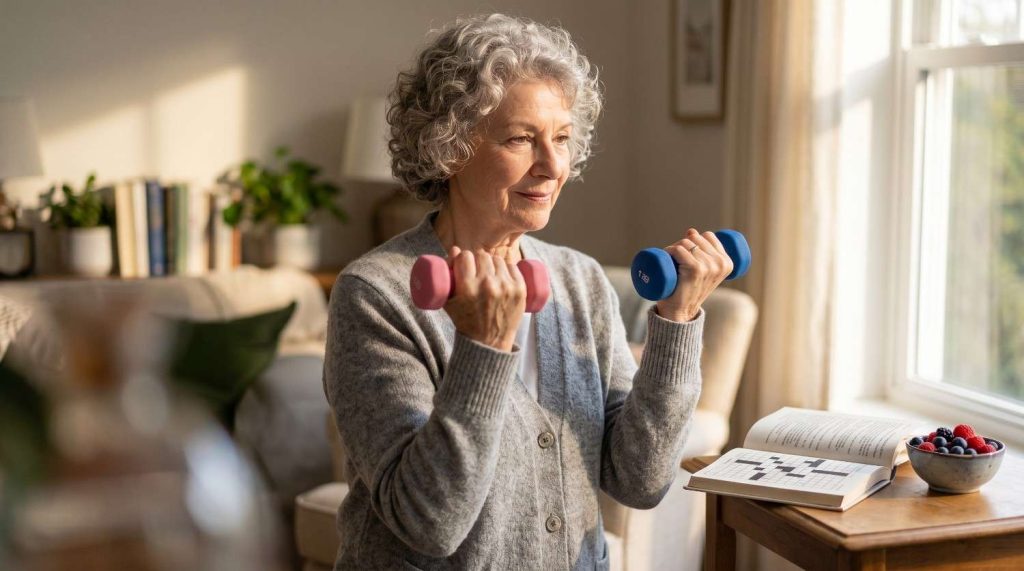
When it comes to staying healthy after the age of 60 or 65, almost every doctor, family member, and health magazine gives the exact same advice: “Just go for a walk.” Don’t get it wrong—walking is an absolute blessing. It gets you outside into the fresh air, improves circulation, lifts your mood, and burns calories. For decades, regular walking has been celebrated as the gold standard of senior fitness. ”strength training for seniors”
However, relying only on walking to maintain your health as you age is actually one of the biggest heart health myths in modern wellness.
While a daily stroll does wonders for your cardiovascular endurance, it completely misses a critical component of healthy aging. If you are not incorporating light resistance exercises into your weekly routine, you are likely losing your valuable muscle mass at an alarming rate.
In this comprehensive guide, we will debunk common fitness myths, explore the deep connection between muscle mass and cardiovascular health, and look at how practicing strength training for seniors twice a week can completely transform your quality of life.
The Silent Thief: Understanding Age-Related Muscle Loss
To understand why walking alone isn’t enough, we first need to look at a natural biological process called Sarcopenia. Sarcopenia is the involuntary loss of skeletal muscle mass and strength that begins around the age of 30, but accelerates dramatically after you cross 65. strength training for seniors
[Age 30+] ---> Lose 3% to 5% Muscle Per Decade
[Age 65+] ---> Accelerated Muscle & Bone Density Loss
When you only walk, you are training your slow-twitch muscle fibers, which help with endurance. However, walking does not challenge your fast-twitch muscle fibers—the ones responsible for power, bursts of energy, and keeping you upright when you accidentally trip.
Without targeted resistance, seniors can lose up to 30% to 50% of their total muscle mass by the time they reach their 80s. This loss of muscle directly leads to: strength training for seniors
- Increased joint pain (especially in the knees and hips).
- A slower metabolism, making weight management incredibly difficult.
- A higher risk of accidental falls and a loss of personal independence.
Debunking the Myth: Why Your Heart Needs Strong Muscles
Many older adults avoid lifting weights because they believe it places too much strain on their cardiovascular system. This is a massive misconception. In reality, your muscles and your heart operate as a team.
When your skeletal muscles are weak, your heart has to work twice as hard to pump blood through your body. Think of your muscles as secondary pumps. Every time a strong muscle contracts, it helps squeeze blood back up toward your heart.
By actively engaging in strength training for seniors, you build denser muscle tissue. This dense tissue absorbs glucose from your bloodstream much more efficiently, significantly lowering your risk of Type 2 diabetes. Furthermore, a muscularly fit body possesses cleaner, more elastic arteries, which naturally lowers high blood pressure—the number one enemy of a healthy heart.
The Magic Formula: Twice a Week is All It Takes
The word “weightlifting” often brings up images of sweaty gyms, heavy iron bars, and extreme exertion. But for older adults, building strength looks entirely different, safe, and highly accessible.
You do not need an expensive gym membership. High-performing health routines show that practicing simple strength training for seniors just twice a week for 20 to 30 minutes is all it takes to trigger massive physical benefits.
[20-30 Mins] x [2 Times a Week] = Stronger Heart + Preserved Muscle Mass
Your body needs roughly 48 hours of rest between strength sessions to rebuild and repair muscle tissue. Therefore, a perfect schedule could be lifting weights or doing bodyweight exercises on Tuesday and Friday, while keeping your beloved walking routine on Monday, Wednesday, and Saturday.
4 Safe and Essential Strength Exercises for Older Adults
If you are ready to upgrade your fitness routine and protect your body from muscle wasting, here are four highly effective, low-impact exercises that focus on strength training for seniors.
1. The Sit-to-Stand (Chair Squats)
- Why it matters: This is the ultimate functional movement for independence. It strengthens your quadriceps, hamstrings, and glutes—the exact muscles you need to get out of a car, off a low sofa, or up from the toilet without help.
- How to do it: Sit on a sturdy kitchen chair with your feet flat on the floor. Without using your hands for assistance, push through your heels and stand all the way up. Slowly lower yourself back down until your bottom grazes the seat. Aim for 8 to 10 repetitions.
2. Wall Push-Ups
- Why it matters: Traditional floor push-ups can be brutal on senior wrists and shoulders. Wall push-ups provide the exact same chest, arm, and core strengthening benefits without the dangerous joint pressure.
- How to do it: Stand an arm’s length away from a flat wall. Place your palms flat against the wall at shoulder height. Keeping your body in a straight line like a plank, slowly bend your elbows to bring your face close to the wall, then push yourself back to the starting position.
3. Dumbbell Bicep Curls (Or Using Water Bottles)
- Why it matters: Upper body strength is vital for carrying groceries, lifting grandchildren, and opening heavy doors.
- How to do it: Hold a light pair of dumbbells (1 to 5 pounds) or two sealed water bottles at your sides. Keeping your elbows tucked closely to your ribs, slowly curl the weights up toward your shoulders, then lower them back down with control.
4. Standing Calf Raises
- Why it matters: Your lower legs control your balance and ankle stability. Strong calves act as a powerful insurance policy against trips and falls.
- How to do it: Stand tall behind your kitchen counter or a sturdy chair and hold onto it lightly for balance. Slowly lift up onto your tiptoes, hold for one second, and then lower your heels back to the ground.
Essential Safety Guidelines for Senior Strength Routines
Before jumping into your new routine, remember that safety and proper form are your top priorities.
| Rule | Action to Take | Why it Matters |
| Never Hold Your Breath | Exhale as you lift, inhale as you lower. | Prevents sudden, dangerous spikes in blood pressure. |
| Start Micro-Light | Begin with 1-pound weights or just your body weight. | Allows your tendons and joints to adapt without injury. |
| Listen to Pain | Muscle fatigue is good; sharp joint pain is a warning signal. | Stops you from overexerting or tearing delicate tissues. |
onclusion: Elevate Your Walking Routine
Walking is a wonderful habit that you should absolutely continue for the rest of your life. It keeps your spirit high and your lungs clear. But if you want to protect your heart, preserve your independence, and stop age-related muscle loss in its tracks, walking can no longer stand alone.
By introducing a targeted routine of strength training for seniors just twice a week, you give your body the balance, power, and structural support it desperately craves. Don’t let your hard-earned muscle vanish. Pick up those light weights, do those chair squats, and turn your golden years into your strongest years yet!