It happens in a fraction of a second.
You are walking across the living room to answer the phone, or reaching up to grab a favorite coffee mug from the top shelf. Your foot catches the edge of a rug, or your ankle gives way just a tiny bit. Suddenly, the floor is coming up to meet you. prevent dangerous falls
When you are over 60, a simple slip is never just a slip. It is one of the most significant hidden threats to your independence.
Statistically, falls are the leading cause of injury among older adults. But here is the piece of information most doctors don’t share: falling is not an inevitable, mandatory part of getting older. Your balance isn’t a permanent setting that simply breaks down as the calendar pages turn. It is a muscle, a skill, and a system that you can actively test, train, and protect.
Before you worry about your next step, let’s find out exactly where your stability stands right now. You don’t need a medical clinic or specialized equipment—just a wall, a flat floor, and exactly ten seconds.
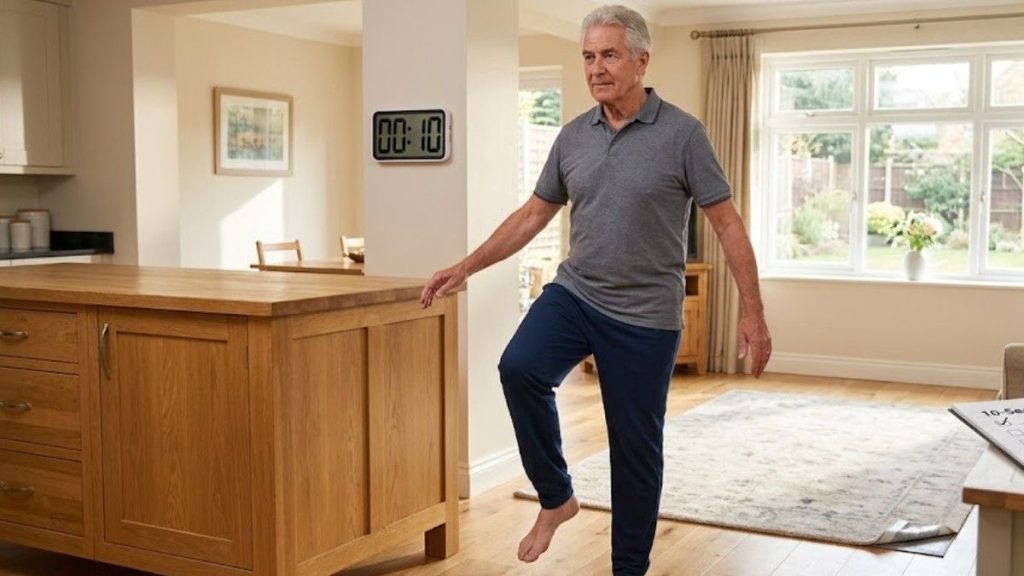
The One-Leg Window: How to Take the 10-Second Balance Test
This simple exercise is used by physical therapists worldwide to instantly gauge an individual’s functional stability and neurological coordination. prevent dangerous falls
How to do it safely:
- Find a clear patch of hard flooring next to a sturdy wall or a heavy kitchen counter for emergency support.
- Stand straight, place your hands on your hips, and fix your eyes on a single stationary spot on the wall directly in front of you.
- Gently lift one foot off the ground, bending your knee so your foot hovers a few inches high. Start your timer.
[Stand Near Sturdy Support] > [Lift One Foot] > [Hold Fixed Eye Contact] > [Aim for 10 Seconds]
- The Scoring System: If you can hold this exact position steadily for 10 seconds or longer without dropping your foot, grabbing the wall, or wildly waving your arms, your balance is in a healthy, proactive zone.
- If you wobbled or dropped your foot under 10 seconds: Do not panic. This is not a failure; it is a vital early warning signal. It simply means the communication network between your brain, inner ear, and lower leg muscles needs a bit of basic tuning. prevent dangerous falls
The Hidden Architecture of Balance: Why We Lose It
To understand how to prevent dangerous falls, we have to realize that our body maintains balance using three interconnected systems:
- Your Vision: Your eyes constantly tell your brain where your head is located relative to your surroundings.
- Your Vestibular System: The delicate, fluid-filled channels inside your inner ear that detect motion and direction.
- Your Proprioception: The tiny sensors inside your ankles, feet, and leg muscles that feel the floor and automatically adjust your weight.
As we age, if we spend a lot of time sitting down or relying strictly on predictable, flat surfaces, these tiny foot sensors and lower leg muscles slowly go to sleep. They lose their sharpness. When your foot encounters an unexpected bump or a slippery patch, the leg muscles don’t fire fast enough to keep you upright.
To rebuild that safety net, we have to wake those muscles back up.
3 Quick Leg-Strengthening Exercises to Restore Stability
You don’t need heavy weights or a gym membership to build fall-proof legs. Spend just 5 minutes a day performing these three highly effective movements:
1. The Bedside Heel-to-Toe Stand (Tandem Stance)
Think of this as walking a tightrope, but with total safety.
- The Move: Stand next to your kitchen counter for support. Place your right foot directly in front of your left foot, so the heel of your right foot touches the toes of your left foot. Look straight ahead and try to balance without holding the counter for 20 seconds. Switch feet.
- Why it works: It forces your brain to narrow its base of support, rapidly sharpening your lower body’s balance sensors.
2. Kitchen Counter Calf Raises
- The Move: Stand facing your counter, lightly placing your fingertips on the surface. Slowly lift up onto the tiptoes of both feet, hold for two seconds, and gently lower your heels back to the ground. Repeat this 10 to 12 times.
- Why it works: It builds explosive strength in your calves and ankles, giving your body the power to instantly correct itself if you happen to trip over an object.
3. The Functional Chair Reset (Sit-to-Stands)
This is the ultimate movement for building independent thigh strength. prevent dangerous falls
[Sit Tall on Sturdy Chair] > [Cross Arms Over Chest] > [Press Through Heels to Stand] > [Slowly Lower Back Down]
- The Move: Sit on a sturdy dining chair. Cross your arms over your chest so you aren’t using your hands to push off. Pressing firmly through your heels, stand all the way up smoothly, then slowly lower yourself back into the seat. Aim for 8 controlled repetitions.
- Why it works: This replicates the exact muscle power required to get out of a car, a low sofa, or a toilet seat safely without losing control.
Home Adjustments: Fixing the Invisible Tripwires
While you are building stronger muscles, take twenty minutes to look around your living environment. Most emergency room visits aren’t caused by major design flaws; they are caused by everyday items we stop noticing.
- Secure the Rugs: Throw rugs are the number one cause of household falls. Use double-sided non-slip tape to secure the corners down completely, or remove them entirely from main walking pathways.
- Light Up the Night: Many dangerous slips happen during midnight trips to the bathroom. Plug cheap, motion-activated LED nightlights into your hallways and bathrooms so you never have to walk through total darkness.
- Clear the Transit Zones: Keep your main walking paths—especially stairs and narrow hallways—completely free of loose charging cords, shoes, and small clutter.
Conclusion: Confidence in Every Single Step
A fear of falling can slowly cause your world to shrink. It might make you hesitate to go for walks, garden, or play with your grandchildren. But fear shouldn’t dictate your lifestyle. prevent dangerous falls
By taking the 10-second balance test and spending just a few minutes a day strengthening your ankles and thighs, you are building an invisible armor around your body. You are taking active control over your physical safety. Clean up those household tripwires, practice your counter exercises, and enjoy the wonderful freedom of moving through your world with total confidence! prevent dangerous falls